
Identify the Onondaga County Deed Before Ordering It
The County Clerk keeps Onondaga County deed records. Start from a current assessment result and its tax map number. Then open Cott eSearch under the owner of record. Search the grantee side for the deed by which that owner took title, and the grantor side for any later conveyance. Write down the document type, parties, recording date, book and page or instrument number, legal-description clues, and cross-references. Do that before buying an image. It also makes a certified copy request far easier.
| Instrument | What to inspect | What it does not prove alone |
|---|---|---|
| Warranty or bargain-and-sale deed | Grantor, grantee, consideration, description, recording data | That no later lien or conveyance exists |
| Quitclaim deed | Interest released and parties' capacity | The quality or extent of the interest conveyed |
| Executor or administrator deed | Estate capacity and court context | The complete probate history |
| Correction deed | Prior instrument reference and corrected term | A new arm's-length sale |
| Mortgage or discharge | Borrower, lender, amount, assignment, release | Ownership by the lender |
Search the Cott Grantor-Grantee Index
Guest access covers the index only. Images and print access require an account or subscription under the displayed terms. Search exact and broad variants, including surname alone, initials, spacing changes, entity suffixes, trustee or executor capacity, and former owner names. A grantor conveys an interest. A grantee receives it. The official County Clerk Cott eSearch shows guest sign-in, and its reverse index usually runs by grantor while the grantee index points toward acquisition.
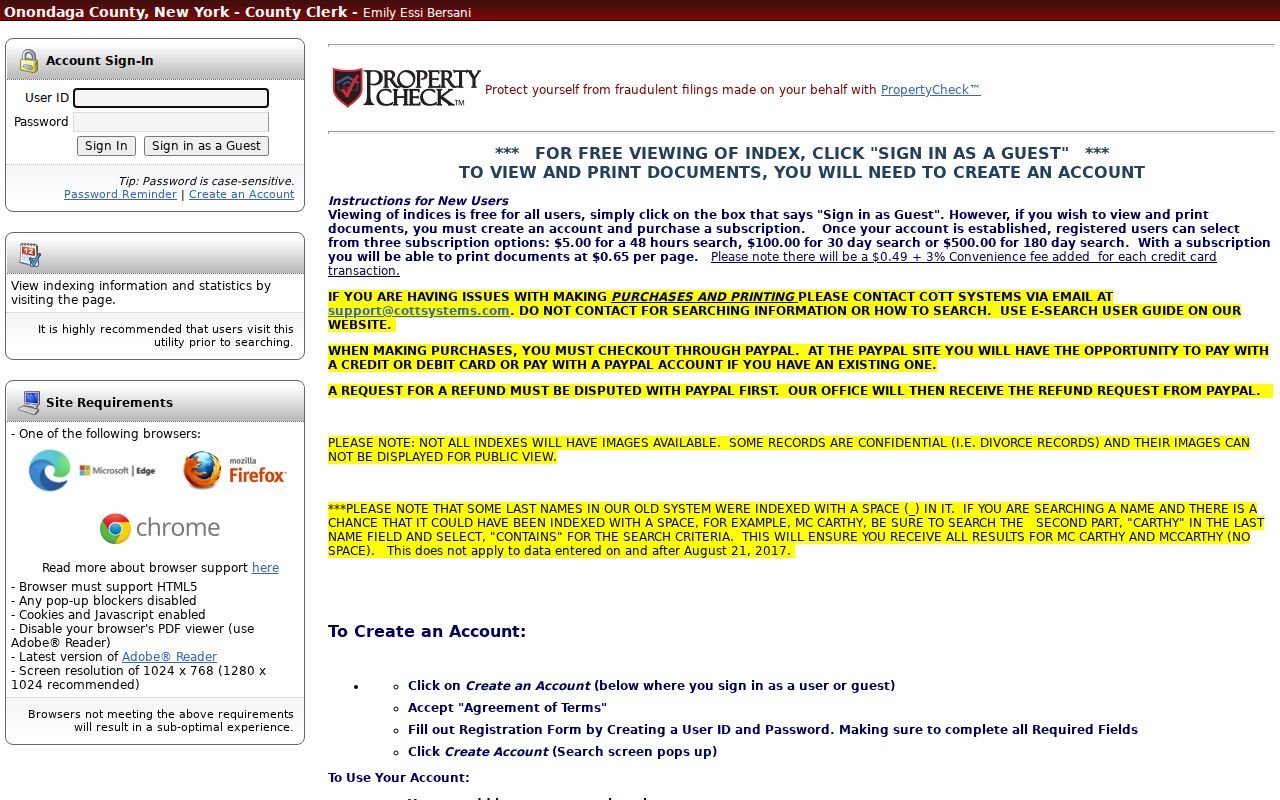
Let the index identify the instrument. Then read the image or official copy, because abbreviated index fields cannot carry the full legal effect of the deed.
Read the Legal Description in an Onondaga County Deed
A modern street address is convenient, but it may not appear in an old deed and is not the legal description. Look instead for subdivision and lot, tract, city block, farm or military lot, metes-and-bounds calls, map references, easements, and adjoining owners. The tax map is the better anchor. Compare the description with it and the filed subdivision plan, and never treat an approximate GIS line as controlling.
An amended subdivision can recode a lot with a suffix such as 10A. It must cite the earlier filed map. Record both original and amended map numbers. The Clerk's subdivision instructions call for a tract name, municipality, farm or military lot or block reference, surveyor certification, original signatures, and other review material. The filing fee is $10. The maximum map size is 36 by 44 inches. The official subdivision filing page lists map format and review requirements. Confirm current requirements before filing.
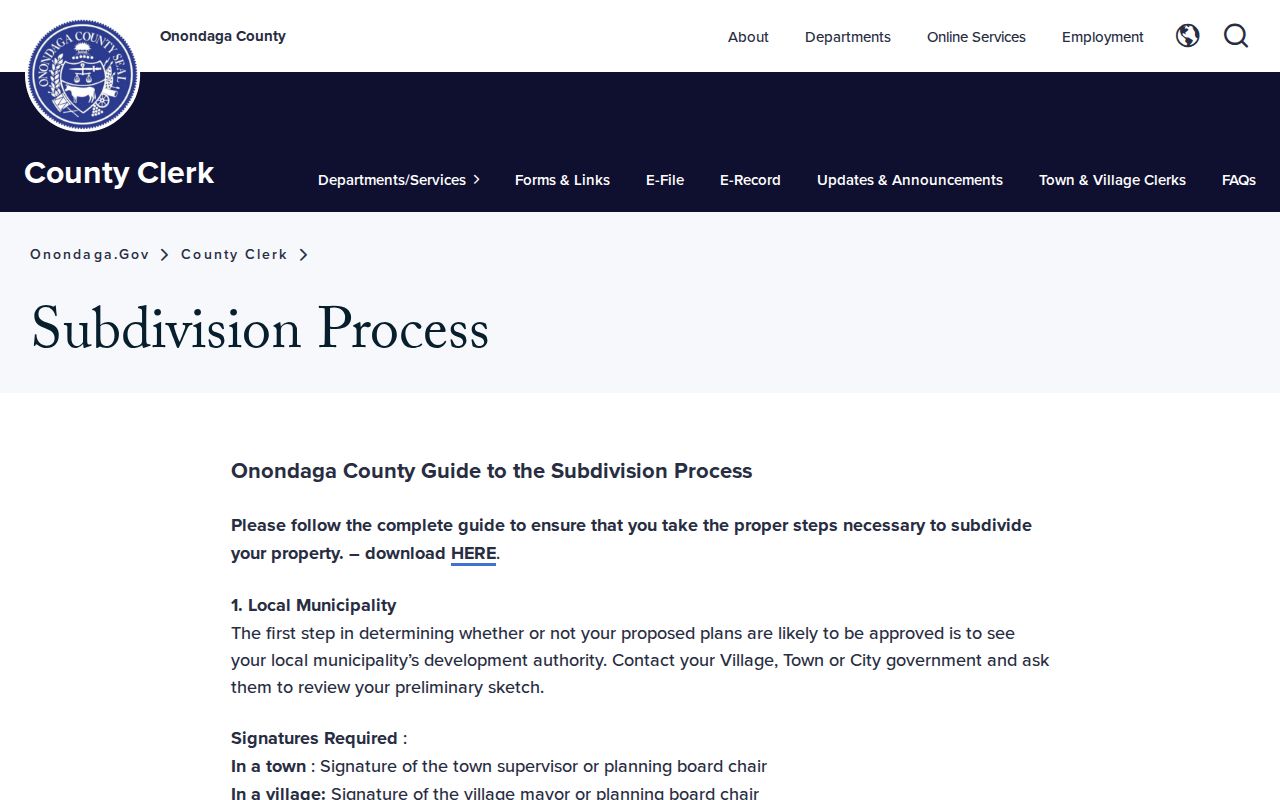
That is why a filed map matters. It can bridge the gap between a deed's lot language and today's parcel number.
Trace Onondaga County Deed Records Back to 1794
The County Clerk states that land records date from 1794. Start with the known current deed. Identify its grantor. Then search that grantor as a grantee for the earlier acquisition. Repeat the process. Record each reference and each break in the chain. Do not assume the online Cott service reaches the start of the physical collection.
Early deeds may be handwritten. They can lean on neighbors, roads, streams, and old tract language. The Clerk Archives, deed books, library microfilm, State Archives finding aids, historic atlases, and city directories can bridge the old description. OCPL's WPA index spans 1814 through 1900 with 52,882 records and can supply an identity clue, but the deed book remains the ownership proof.
Follow Estate, Foreclosure, and Lien Clues
A chain may pass through an executor, administrator, referee, heir, or trustee. Search Onondaga Surrogate material for the estate context. Then return to the County Clerk for the recorded deed. A lis pendens, judgment, foreclosure docket, referee deed, mortgage assignment, and discharge are separate events. Link them by names, dates, and index numbers. Never collapse them into one transaction.
County Clerk fee categories include mechanic's and common-charge liens. They also include federal tax liens and releases, mortgage documents, judgments, UCC material, and real-property releases. A court-record search costs $5 per name. It covers one two-year period. It excludes judgment searches, so confirm the current schedule and scope before ordering.
Choose an Onondaga County Deed Copy Route
Use a portal image for reading and preliminary research. Request a certified copy when an agency, court, lender, or transaction requires official certification. For material not visible online, contact the Clerk at 401 Montgomery Street, Room 200, Syracuse, NY 13202, telephone (315) 435-2227, or consult the archive route. General public hours are listed as weekdays from 8:30 a.m. to 4:00 p.m., with a monthly first-Tuesday closure noted by the Clerk. Verify the live schedule before visiting.
Cott terms in the source set list subscription options and a per-page print charge. Specialized recording and certification fees are separate. Give staff the instrument number or book and page, parties, date range, and document type. That precise request is more effective than asking for every deed connected to an address.
Monitor New Onondaga County Deeds With PropertyCheck
PropertyCheck is a free alert service from the County Clerk. It watches for new recordings against names you register. Register personal, trust, and business name variants. That way nothing slips past a slight spelling difference. When an alert arrives, pull the index entry and instrument. Then call the Clerk at its published number. The alert itself settles nothing. It never determines ownership, validates a signature, or blocks a recording. The official PropertyCheck page walks through sign-up and recording notifications.
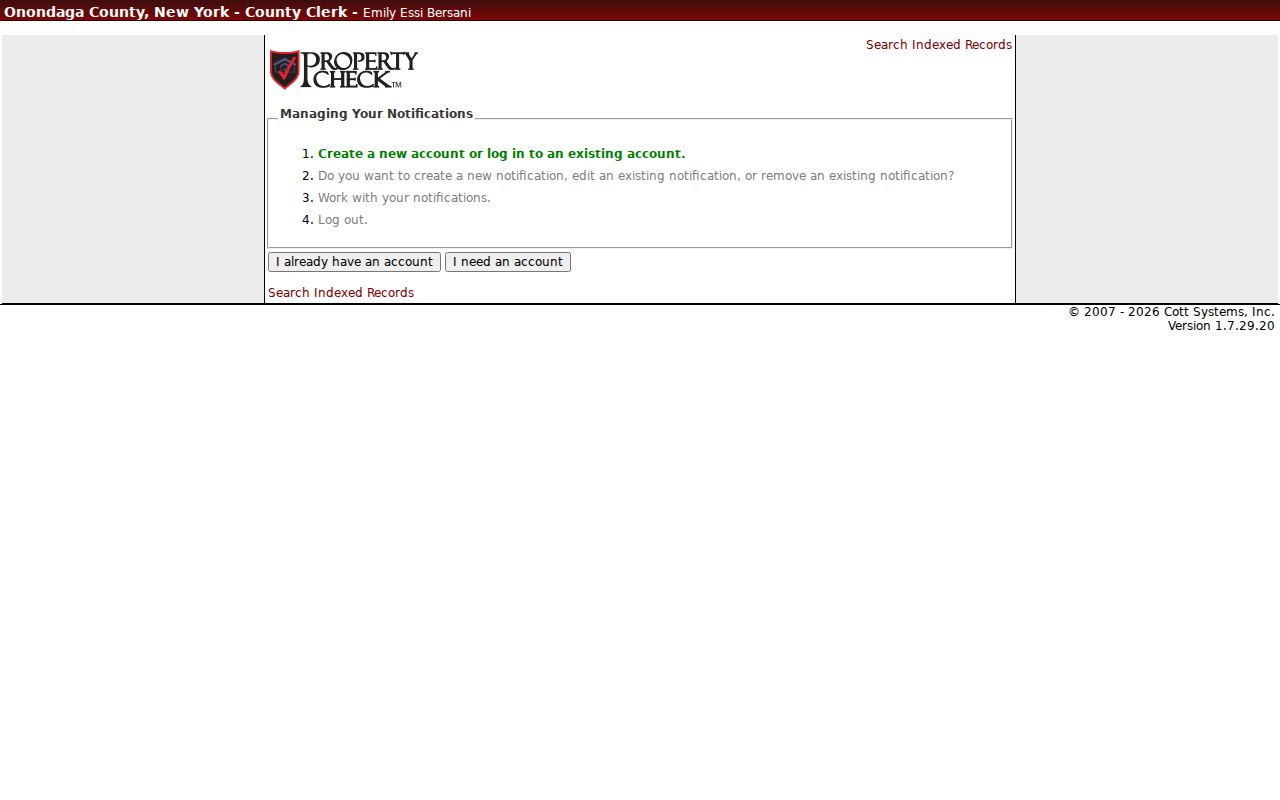
An alert is only the starting point. Match each notice promptly to the actual Clerk instrument before drawing any conclusion about the property records.
Know What Onondaga County Deed Records Cannot Settle
A deed search is not a title examination. Indexes can omit confidential material, and names get misindexed more often than people expect. An unrecorded interest may never surface at all. The parcel map is not a survey, and a stated consideration rarely proves market value. The assessment's owner of record can also lag behind the newest recording. Bring in a title professional for an insurable ownership opinion. A licensed surveyor should settle any disputed boundary.
Evidence rule. Cite the recorded instrument and its legal description, not a search-result snippet, when a deed fact matters.
Prepare a Precise Clerk Copy Request
Precision makes a Clerk copy request work. Include the instrument number or book and page, the document type, the parties, and the recording date whenever you can. Say plainly whether you want a plain image or a certified copy. Confirm the fee before sending payment. A precise request keeps you from receiving a similarly named party's deed, and it builds a clean citation for later title or historical work. Keep the receipt and certification page with the instrument for any mail or counter service.
Cite Every Deed in the Chain
A durable deed citation covers the whole chain. Record the office, instrument type, parties, recording date, book and page or instrument number, and the parcel or legal-description match. Note what you relied on. Was it an index, an image, a plain copy, or a certified copy? That habit stops a thin lead. An index-only entry should not harden later into an assumed reading of the full conveyance.